
Your clients train hard 5 days a week and still not see results? What they eat between sessions undoes most of it. For personal trainers and nutritionists, this is the gap that separates average outcomes from real ones.
Research consistently shows that combining diet with training outperforms exercise alone, and the result lasts for 12 weeks longer.
Your clients know food matters. The problem is the generic meal plan that doesn’t fit their life, their schedule, their preferences, or their budget. A plan they can’t follow is just a PDF they ignore.
Follow this step-by-step guide on how to create a personalized meal plan for clients, from weight gain and fat loss to athletes and women in their 40s, so they eat for better workout results and actually stick with it.
Step 1: Run a client assessment
The assessment is where you collect everything that makes the nutrition plan actually work for that person.
You can build this into a client intake form with Everfit Forms and send it automatically before the first session. You get the information you need upfront, and the client feels heard before you’ve built anything.
Goals and general health
Start knowing what the client wants to achieve and what their body needs you to know.
Questions to ask:
- What is your main goal right now?
- Do you have any diagnosed health conditions that affect how you should eat (thyroid issues, high blood pressure, Type 2 diabetes)
- Do you take any regular medications?
- Do you have any food allergies or intolerances I should know?
- Collect their BMI and body weight. Go further with body fat percentage, lean body mass, TDEE, and activity level if possible.
When should a personal trainer refer to a dietitian? If a client has a clinical condition that requires medical nutrition therapy (such as a history of disordered eating) refer them to a Registered Dietitian. Your role is supporting healthy clients, not treating conditions.

Lifestyle
A meal plan that doesn’t fit someone’s actual life won’t be followed.
A client who works 10-hour days and has two kids needs quick, nutrient-dense foods in under 20 minutes or batch-friendly meals to rotate all week. That’s a completely different plan than someone who works from home and enjoys cooking.
Questions to ask:
- How much time do you realistically have to cook on a weekday?
- Do you meal prep, or do you prefer to cook fresh each day?
- What’s your rough weekly grocery budget for food?
- How often do you eat out or order in?
- Do you prefer structured meal times or more flexibility throughout the day?
Food preferences
You need to know what the client actually enjoys eating, what they won’t touch, and whether there are any cultural or religious dietary requirements that shape their choices.
Questions to ask:
- Are there foods you genuinely enjoy eating? What are some go-to meals you already like?
- Are there any foods you won’t eat?
- Do you follow any dietary guidelines for cultural or religious reasons (halal, kosher, vegetarian, etc.)?
Step 2: Define the nutrition framework
This is where nutrition programming for clients gets specific. And where most generic plans fall apart as they treat everyone the same.
Set up a target.
The most common way to estimate a client’s calorie target is multiplying their BMR by a TDEE activity multiplier. Tools like NASM Calorie Calculator or Everfit Meal Planner will suggest a suitable macro target based on a client’s goal and current BMI, using the same formula.
Once you have a baseline, set the goal:
- Fat loss: 300–500 calorie deficit per day
- Maintenance: at TDEE
- Muscle gain: 250–500 calorie surplus
Once you have the number, flag the non-negotiables from the assessment: dairy-free, gluten-free, vegan, halal, so clients can adopt the plan immediately without having to change their daily habits abruptly.
Also read: Macros Made Simple: A Coach’s Guide to Understanding and Teaching Macros
Choose a diet framework
Here are some approaches to consider based on client type.
Meal plan for athletes.
- In-season, carbs are the priority for fuel and recovery. The benchmark is 5–7 g/kg/day for general training, up to 7–10 g/kg for endurance.
- Off-season is when the focus shifts to building the physical base for next season: decrease carbs, increase protein.
💡Practical framework: The ISSN Performance Diet for athletic fueling

Clients with diabetes or blood sugar goals
- Carb quality and meal timing matter more than total carbs. Spread carbohydrates evenly across meals.
- Keep protein and fiber high at every meal to blunt post-meal glucose spikes.
- If the client is medicated, build the plan with RD oversight.
💡Practical framework: DASH diet, Mediterranean diet, Keto diet.
Women in their 40s with fat loss goals
- Declining estrogen changes how the body stores fat and regulates blood sugar. Push protein toward the higher end (1.6–2.0 g/kg) to preserve muscle mass.
- Prioritize fiber-rich whole foods, and reduce refined carbohydrates.
- A modest deficit of 250–300 calories works better here than aggressive restriction, which can worsen hormonal balance.
💡 Practical framework: Mediterranean diet, Low-carb & High-protein approach.
Muscle gain
- High protein (1.6–2.2 g/kg), moderate surplus (250–500 calories above TDEE), and carbohydrates centered around training sessions.
- Distribute protein across 3–4 meals rather than loading it at the end of the day.
💡 Practical framework: Reverse dieting, The anabolic diet, High-protein.
Calories and macros get the most attention but they’re not the whole picture.
- Hydration affects performance, recovery, and hunger signals. A standard baseline is 35 ml per kg of bodyweight per day.
- Micronutrients — iron, calcium, vitamin D, magnesium, zinc, fiber — become particularly important for clients eating in a deficit, athletes with high output, and women over 40.
Also read: The 3-Tier Meal Prep System: A Smarter, Sustainable Approach to Nutrition Coaching
Step 3: Build the meal plan
This is where the assessment and the framework come together into something a client can actually use. The goal isn’t a perfect plan on paper but a plan the client will follow consistently.
That starts with one decision: Structured or Flexible meal plan?
| Structured meal plan | Flexible meal plan | |
|---|---|---|
| How | Tells the client exactly what to eat and when. Monday breakfast is X, Tuesday lunch is Y. | Set the calorie targets, macro goals, and dietary restrictions, then give clients recipe options within their meal schedule |
| Risk | High pressure. Clients might go off-plan, and many won’t get back on it. | Requires more upfront work to build a proper collection. |
| Best for | Beginner clients. Clients with health problems that needs to follow strict diets. Clients in a strict phase such as competition prep. | Most clients. It’s sustainable and easily fits into real-life. |
Tips for building a meal plan clients will actually stick to:
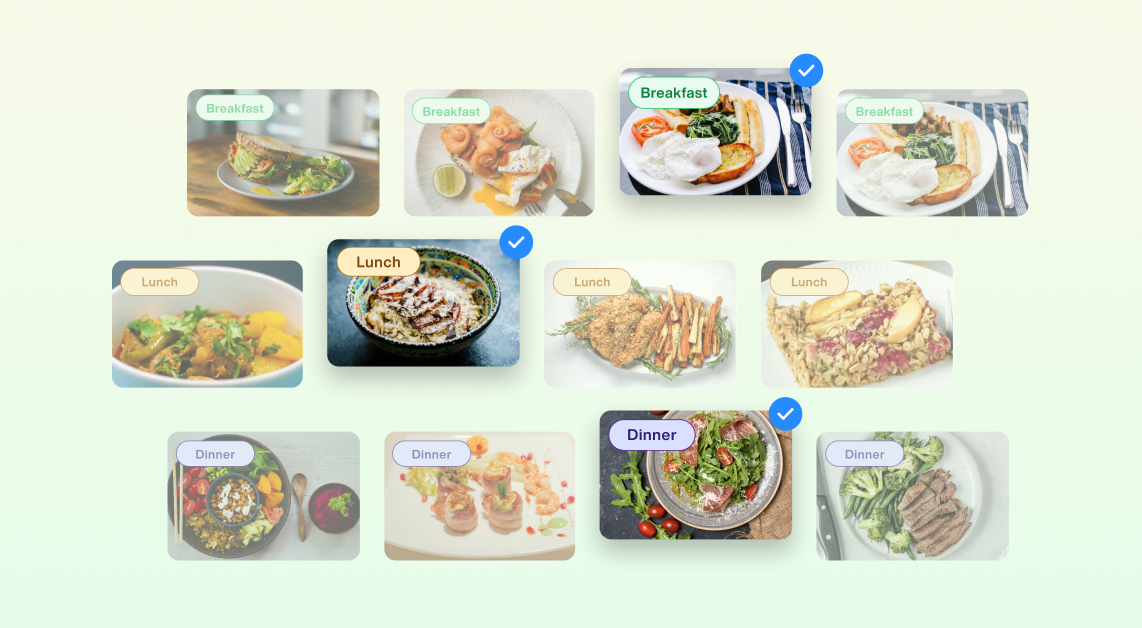
- Build a collection of 5 to 10 recipe options per meal category (breakfast, lunch, dinner, and snacks) that all hit roughly the same macro targets. You and clients can rotate through without thinking too hard and avoid boredom.
- Include images, macro info, ingredients, and a how-to guide for each recipe. The fewer questions a client has to ask themselves, the more likely they are to just do it.
- Prioritize quick recipes for busy clients. Flag prep and cook time on every recipe and make sure the weekly plan isn’t front-loaded with time-intensive meals.
- Include batch-cooking friendly options. Soups, grain bowls, sheet pan proteins, meals that make 3–4 servings at once. One prep day covers most of the week. This works especially well for clients who struggle with consistency mid-week.
- Rotate the collection every few weeks. Swap in 1–2 new recipes every few weeks to keep the plan fresh without rebuilding it from scratch.
- Generate a grocery list from the plan. Everfit can quickly make a shopping list from their assigned meal plans. Removing the friction between having a plan and actually following it. Clients know exactly what to buy, in what quantity, for the whole week.
- Allow meal swaps. You can let clients swap a meal that still meets their dietary constraints for extra flexibility. You can also modify a standard recipe into different variants, such as vegan, high-protein, and low-fat with Everfit to match individual dietary preferences.
Step 4: Deliver the plan
Building a great meal plan is only half the job. How you deliver it determines whether the client actually uses it.
There are three main options: spreadsheet, PDF, or dedicated software
| Spreadsheet or PDF | Nutrition coaching platform (Everfit) | |
|---|---|---|
| What it is | The easiest way to put together a plan and share it quickly. | The most effective ways to create, assign, track, adjust meal plans, and engage with clients |
| Time to build a plan | 2 to 4 hours | Under 15 minutes. Generate meals based on dietary preferences, goals, and more. |
| Client intake form | Set up elsewhere to get insights | Set up in the app. Automatically send to clients. Data in one place, ready to use. Various form templates. |
| Macro goals estimation | Manual | Automatic |
| Create recipe | Manual. Create them yourself. | 3000+ recipes or transform the PDF into a recipe with AI. |
| Adjust meal plans | Difficult. Rigid | Easy to modify recipe, adjust goals, and update plans. |
| Grocery list | Manual | Generate automatically. |
| Deliver meal plans | Manual | Can be automated. |
| Macro tracking | Clients have to use other apps | In-app tracking with food search or AI Meal Scanner. |
| Pricing & ROI | Free but hard to scale. | 30-day trial. Free to coach 5 clients. Start at $19/month. |
| Scalability | Low. | High. |
| Best for | – One-off consultations. – Low-ticket support (e.g. a 14-day trial meal plan as a lead generation) – New coach. | – Scalling coaches. – Nutritionists, Personal trainers, and Dietitians with a high focus on personalizing meal plans. |
If nutrition is a real part of your service and you’re managing more than a handful of clients, a platform that combines meal planning with the rest of your coaching workflow is what makes it sustainable.
Step 5: Check in, monitor, and adjust
The plan you build in week one is a starting point.
The check-in process is what turns a decent plan into one that actually gets results and what keeps clients engaged long enough to see them. Coaches who do this consistently have clients who stay longer, refer more, and produce the kind of results that become testimonials.
- Weekly for new clients or active phases.
- Bi-weekly once they’ve found their rhythm.
- Monthly for maintenance clients.
Keep the format simple. Everfit can automatically send a short check-in form to cover adherence, energy, hunger, lifestyle changes, and any metric updates. Short enough that clients actually fill it out.

Don’t rely on clients to reach out when they’re struggling as many of them won’t. Build the structure in from the start:
- Automated check-in forms on a fixed schedule.
- In-app meal tracking so you can spot patterns and missed days between check-ins.
- Habit tracking alongside the meal plan.
- Easy in-app messaging for quick questions mid-week.
Everfit handles all of this in one place, so accountability runs in the background without adding admin work.
Wrapping Up
Creating a personalized meal plan for a client isn’t complicated. It requires a process. Assess first, set the right framework second, build flexibility into the plan, deliver it in a format clients will actually use, and stay close enough to adjust as they progress.
The coaches who get the best results don’t just write great programs. They close the gap between training and nutrition — and that’s what keeps clients longer, gets them better outcomes, and builds a business worth running.
References:
- Kazeminasab, F., et al. (2025). Journal of the International Society of Sports Nutrition.
- Tagawa, R., et al. (2022). Synergistic Effect of Increased Total Protein Intake and Strength Training on Muscle Strength
- Bian, L., et al. (2026). Association between carbohydrate quality and glycemic control in individuals with type 1 diabetes
- Erdélyi, A., et al. (2023). The Importance of Nutrition in Menopause and Perimenopause